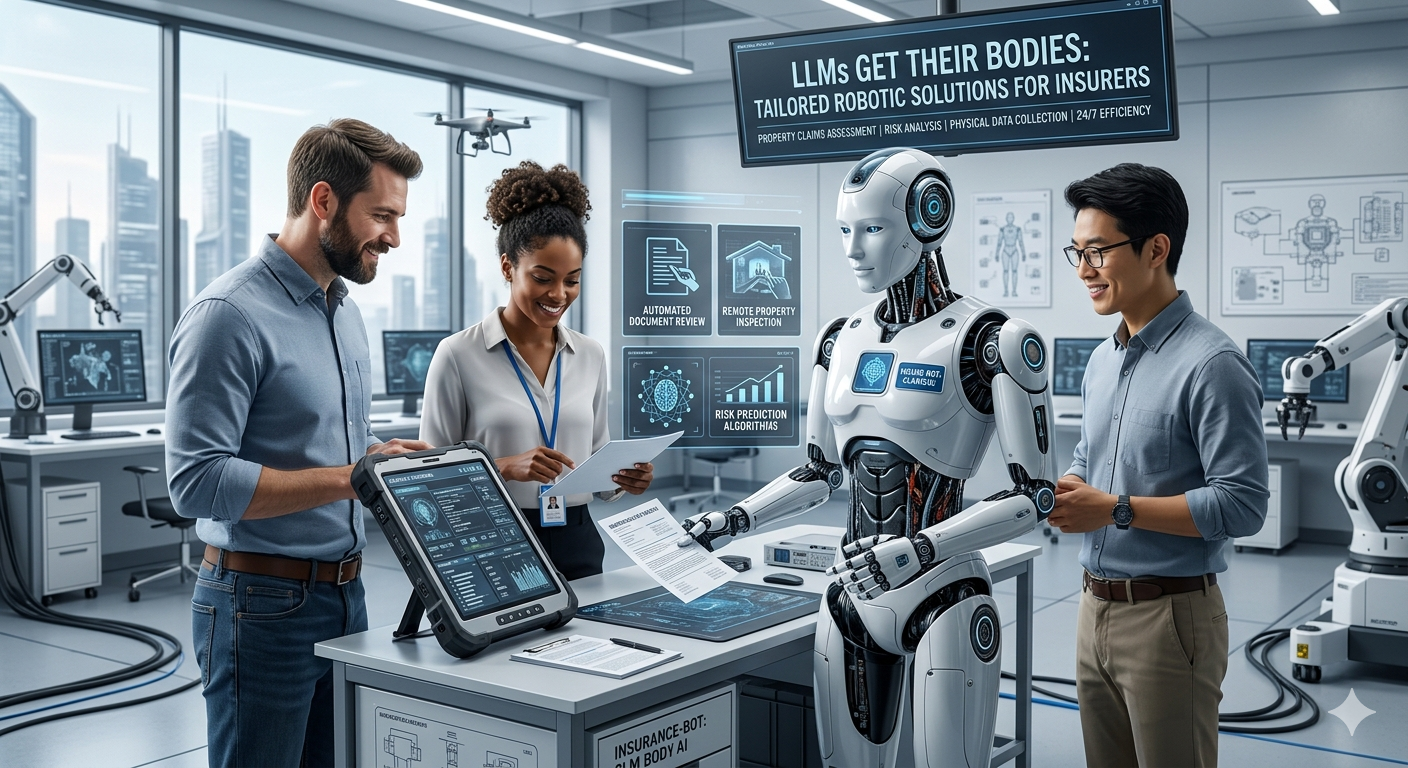
The insurance industry has long relied on data, analytics, and human expertise to assess and manage risk. But a new frontier is emerging—one where large language models (LLMs) are no longer confined to software interfaces. Instead, they are being integrated into physical robotic systems, giving them a “body” to interact with the real world. For insurers, this convergence of AI and robotics opens up transformative possibilities.
From Digital Intelligence to Physical Action
LLMs have already proven their value in underwriting, claims processing, and customer service. However, their capabilities have been largely limited to interpreting and generating text. By embedding LLMs into robotic systems—such as drones, inspection robots, and autonomous devices—insurers can extend AI from decision-making to real-world execution.
Imagine a claims process where:
- A policyholder reports damage via an app
- An AI-powered drone is dispatched automatically
- The drone assesses the damage, guided by an LLM interpreting policy language
- A claim decision is generated in near real time
This is no longer theoretical—it is rapidly becoming feasible.
Key Applications in Insurance
1. Automated Claims Inspection
Robots equipped with cameras and sensors can inspect:
- Property damage after natural disasters
- Vehicle accidents
- Industrial site incidents
LLMs enable these systems to interpret complex policies and guide inspections based on coverage rules, reducing human error and speeding up settlements.
2. Risk Assessment & Underwriting
Robotic systems can collect real-time environmental and structural data. Combined with LLMs, they can:
- Analyze compliance with safety standards
- Identify hidden risks
- Generate underwriting reports automatically
This creates a more dynamic and data-driven underwriting process.
3. Fraud Detection
Fraud is a major challenge for insurers. Robotic inspections powered by LLM reasoning can:
- Cross-check physical evidence with claims descriptions
- Detect inconsistencies
- Flag suspicious patterns for further investigation
4. Customer Experience Enhancement
Deploying robotics in customer-facing scenarios—such as home inspections or on-site assistance—can significantly improve service speed and transparency. LLMs ensure these interactions remain conversational and personalized.
Why Tailored Solutions Matter
Generic robotics solutions are not enough for insurance. Each insurer operates with:
- Unique policy structures
- Different regulatory environments
- Specific risk portfolios
Therefore, tailored robotic systems are essential. These systems must be trained on:
- Proprietary policy documents
- Historical claims data
- Industry-specific scenarios
Customization ensures that robotic actions align precisely with business objectives and compliance requirements.
Benefits for Insurers
- Faster Claims Processing: Reduced turnaround time from days to hours
- Cost Efficiency: Lower reliance on manual inspections
- Improved Accuracy: Data-driven decisions with fewer human biases
- Scalability: Ability to handle large volumes during catastrophe events
Challenges and Considerations
Despite the promise, several challenges remain:
Regulatory Compliance
Insurance is heavily regulated. Deploying autonomous systems requires adherence to strict legal frameworks, especially around data usage and decision-making.
Data Privacy & Security
Robotic systems collect sensitive data, including images of private property. Ensuring secure handling of this data is critical.
Ethical Concerns
Balancing automation with human oversight is essential to maintain fairness and accountability.
Integration Complexity
Combining LLMs with robotics, legacy systems, and existing workflows can be technically demanding.
The Road Ahead
As AI and robotics continue to evolve, insurers that invest early in tailored solutions will gain a competitive advantage. The future may include:
- Fully autonomous claims ecosystems
- Predictive risk monitoring using continuous robotic data collection
- Integration with smart homes and IoT devices
LLMs with “bodies” represent a shift from passive intelligence to active, real-world problem solving.
Conclusion
The fusion of LLMs and robotics is poised to redefine how insurers operate. By moving beyond digital interfaces into physical environments, insurers can achieve unprecedented efficiency, accuracy, and customer satisfaction.
In this new era, the question is no longer whether AI will transform insurance—but how quickly insurers can adapt to a world where intelligent systems don’t just think—they act.